
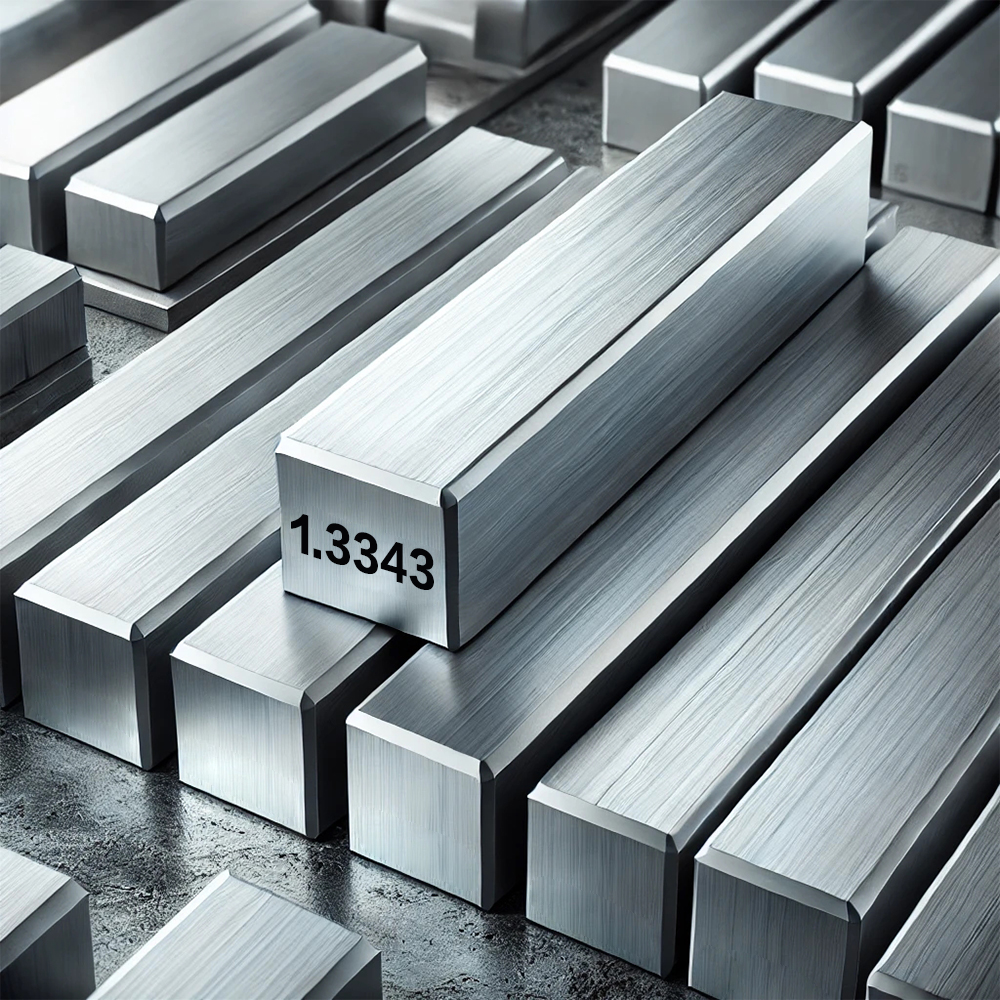
1.3343 High-Speed Steel (HSS) Detailed Information
1.3343 is a tungsten-molybdenum high-speed steel (HSS), equivalent to AISI M2 and JIS SKH51. It is one of the most commonly used high-speed steels, known for its high hardness, excellent wear resistance, and good toughness. This material is widely used in cutting tools, punches, drills, milling cutters, and cold work applications.
Key Features
High Hardness & Wear Resistance
- Achieves 62 – 67 HRC after heat treatment.
- Suitable for high-performance cutting tools.
Good Red Hardness
- Maintains hardness and strength at elevated temperatures.
- Ideal for high-speed machining applications.
Good Toughness & Impact Resistance
- Performs better than tungsten-based HSS in shock-loading applications.
High Cutting Efficiency
- Provides sharp and durable edges for cutting tools.
Better Machinability (Compared to Other HSS Grades)
- Easier to grind and process than tungsten-heavy tool steels.
Chemical Composition
| Element | Composition (%) |
| Carbon (C) | 0.86 – 0.94 |
| Tungsten (W) | 5.50 – 6.70 |
| Molybdenum (Mo) | 4.50 – 5.50 |
| Vanadium (V) | 1.70 – 2.10 |
| Chromium (Cr) | 3.80 – 4.50 |
| Cobalt (Co) | ≤ 1.00 |
| Silicon (Si) | ≤ 0.45 |
| Manganese (Mn) | ≤ 0.40 |
| Phosphorus (P) | ≤ 0.030 |
| Sulfur (S) | ≤ 0.030 |
- Tungsten (W) & Molybdenum (Mo) → Enhance hardness and red hardness (heat resistance).
- Vanadium (V) & Chromium (Cr) → Improve wear resistance and toughness.
- High Carbon (C) Content → Provides excellent cutting performance.
Mechanical Properties
| Property | Value |
| Density | 8.1 g/cm³ |
| Tensile Strength | ≥ 2,500 MPa |
| Yield Strength | ≥ 1,900 MPa |
| Hardness (Annealed) | ≤ 255 HB |
| Hardness (Hardened) | 62 – 67 HRC |
| Thermal Conductivity | 23.0 W/m·K |
| Melting Point | 1,260 – 1,280°C |
- High hardness (up to 67 HRC) after heat treatment.
- Good red hardness (maintains strength at high temperatures).
- Excellent wear resistance, making it ideal for cutting tools.
1.3343 vs. Other High-Speed Steels
| Property | 1.3343 (M2 HSS) | 1.3243 (M35 HSS) | 1.3247 (M42 HSS) | D2 Tool Steel |
| Hardness (HRC) | 62 – 67 | 63 – 66 | 65 – 68 | 58 – 62 |
| Wear Resistance | High | Higher | Very High | Excellent |
| Red Hardness | Good | Better | Best | Low |
| Toughness | Good | Moderate | Lower | Better |
| Cobalt Content | None | 5% | 8 – 10% | None |
| Applications | General HSS tools | Cobalt-alloyed tools | Ultra-high hardness tools | Cold work applications |
Why Choose 1.3343?
- More affordable than cobalt-alloyed HSS (M35, M42).
- Best choice for general-purpose high-speed cutting tools.
Applications
Cutting Tools
- Drills, milling cutters, taps, broaches, and saw blades.
Punching & Stamping Dies
- Cold work punches and press tools.
Metal Forming Tools
- Extrusion dies, drawing dies, and thread rolling tools.
Machine Components
- High-wear parts in machines and aerospace applications.
High-Performance Blades
- Woodworking tools, knives, and precision cutters.
Heat Treatment Process
Tempering at lower temperatures (500 – 550°C) retains maximum hardness.
Annealing
- Heat to 820 – 880°C, then slow cool in a furnace.
- Softens the material for easier machining.
Hardening (Quenching)
- Heat to 1,180 – 1,250°C, then oil or air quenching.
- Achieves maximum hardness (62 – 67 HRC).
Tempering
- Heat to 540 – 560°C, then air cool.
- Adjusts hardness and toughness.
Alternative Materials
- 1.3243 (M35 HSS) → Contains 5% cobalt for better red hardness.
- 1.3247 (M42 HSS) → Contains 8 – 10% cobalt for maximum wear resistance.
- D2 (1.2379) → For cold work applications, but lacks red hardness.
Conclusion
1.3343 high-speed steel (M2 HSS) is a versatile and widely used cutting tool material, offering a great balance of hardness, toughness, and red hardness.
Best for: General-purpose cutting tools, punches, and cold work dies.
Why Choose 1.3343? It provides excellent wear resistance and durability at an affordable cost.