
DAC10 Material Detailed Information
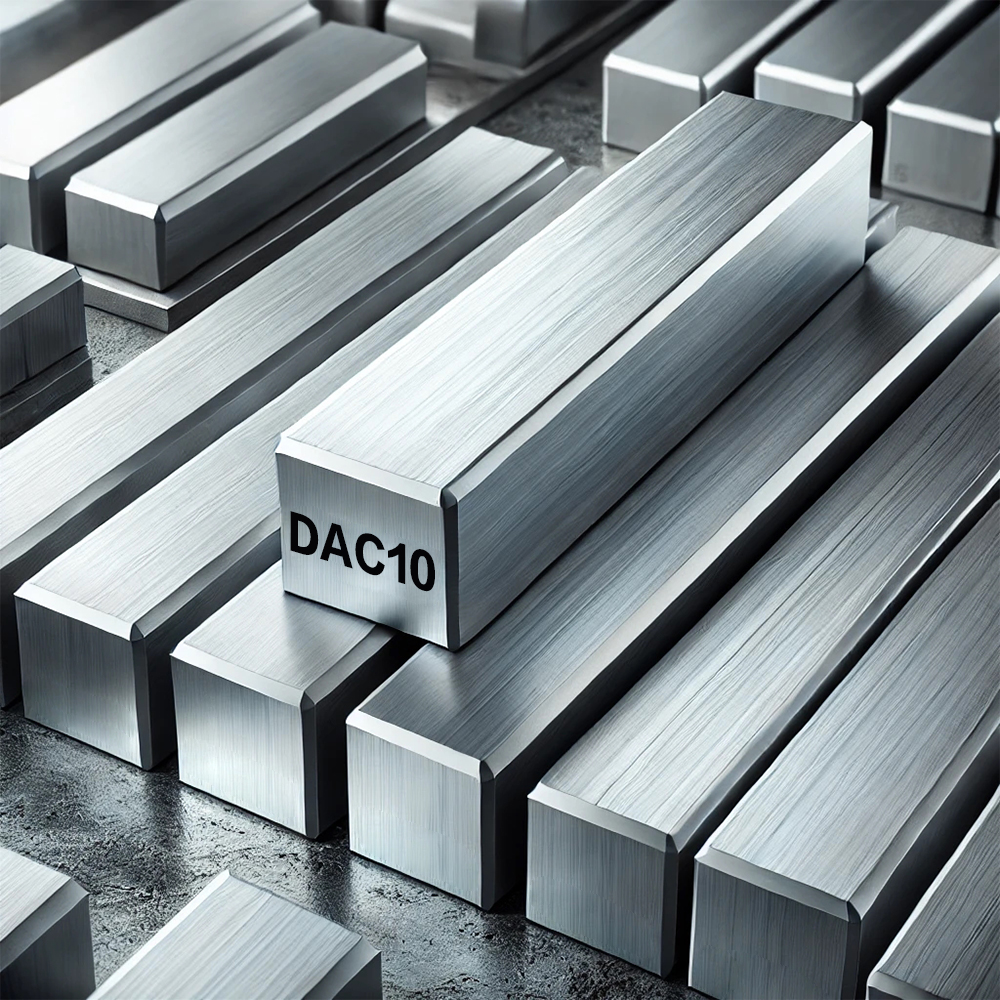
DAC10 is a high-performance hot work tool steel developed by Daido Steel as an improved version of H13 (AISI) and 1.2344 (DIN). It is designed to provide enhanced toughness, wear resistance, and thermal fatigue resistance, making it ideal for die casting, forging, and extrusion applications.
Compared to standard DAC (H13 equivalent), DAC10 offers superior toughness and better heat resistance, resulting in longer tool life and reduced cracking risk in high-temperature environments. It is particularly suitable for high-pressure die casting molds and hot forging dies, where extreme thermal and mechanical stresses occur.
Key Features
- Superior Thermal Fatigue Resistance: DAC10 is engineered for high-pressure die casting molds and forging dies, where tools experience repeated heating and cooling cycles.
- Excellent Wear & Abrasion Resistance: With its optimized vanadium and molybdenum content, DAC10 maintains surface hardness and durability under high loads.
- High-Temperature Strength & Toughness: The addition of nickel and cobalt significantly improves impact resistance and thermal stability.
- Reduced Risk of Cracking: Compared to standard DAC and H13, DAC10 has better resistance to heat-checking and thermal stress cracking.
- Extended Tool Life: The combination of better toughness, wear resistance, and heat resistance results in a longer service life for molds and dies.
Chemical Composition
| Element | Composition (%) |
| Carbon (C) | 0.35 – 0.42 |
| Silicon (Si) | 0.80 – 1.20 |
| Manganese (Mn) | 0.30 – 0.50 |
| Chromium (Cr) | 4.80 – 5.50 |
| Molybdenum (Mo) | 1.20 – 1.50 |
| Vanadium (V) | 0.30 – 0.60 |
| Nickel (Ni) | 0.30 – 0.80 |
| Cobalt (Co) | 0.30 – 1.50 |
| Phosphorus (P) | ≤ 0.030 |
| Sulfur (S) | ≤ 0.020 |
Key Differences from DAC (H13 Equivalent):
- Added Nickel (Ni) & Cobalt (Co): Enhances toughness, heat resistance, and impact strength.
- Optimized Vanadium (V) Content: Increases wear resistance and grain refinement.
Mechanical Properties
| Property | Value |
| Hardness (Annealed) | ≤ 229 HB |
| Hardness (Hardened & Tempered) | 46 – 52 HRC |
| Tensile Strength | ~1,600 MPa |
| Yield Strength | ~1,350 MPa |
| Elongation | 10 – 14% |
| Impact Toughness | Higher than DAC and H13 |
Advantages of DAC10:
- Higher toughness than DAC and H13
- Better resistance to thermal fatigue and cracking
- Improved heat resistance, reducing softening at high temperatures
- Longer tool life in extreme conditions
- Good machinability in the annealed state
DAC10 vs. DAC vs. H13 vs. 1.2344 (DIN)
| Property | DAC10 | DAC | H13 (AISI) | 1.2344 (DIN) |
| Hardness (Tempered) | 46-52 HRC | 46-52 HRC | 45-50 HRC | 45-50 HRC |
| Wear Resistance | Excellent | Excellent | Good | Good |
| Toughness | Superior | High | Moderate | Moderate |
| Thermal Stability | Excellent | Excellent | Good | Good |
| Thermal Fatigue Resistance | Superior | Excellent | Good | Good |
| Applications | Die casting, forging, extrusion dies | Die casting, hot work tooling | General hot work tooling | Hot work tooling |
Why Choose DAC10 Over H13?
- Higher toughness and fatigue resistance, reducing the risk of thermal cracking.
- Better performance in high-pressure die casting molds, extending tool life.
- Optimized for repeated thermal cycling, making it more durable than standard H13.
Applications
DAC10 is widely used in industries that require high-performance hot work tool steels, particularly for die casting, forging, extrusion, and hot stamping.
Die Casting Dies & Cores
- High-pressure aluminum, magnesium, and zinc die-casting molds
- Shot sleeves and plunger tips for continuous molten metal exposure
Forging Dies & Hot Work Tooling
- Hot forging dies for automotive and aerospace components
- Hammer and press forging tools subjected to repeated thermal stress
Plastic Molding & Extrusion Dies
- Injection molding molds requiring high wear resistance
- Extrusion dies for plastic, rubber, and metal materials
Hot Shear Blades & Cutting Tools
- Hot cutting knives for metal shearing at high temperatures
Heat Treatment Process
Annealing
- Heat to 850–900°C, then slowly cool in a furnace.
Hardening
- Preheat at 600–700°C, then heat to 1,020–1,060°C, followed by oil or air quenching.
Tempering
- Temper at 540–620°C (twice) to achieve 46-52 HRC.
Surface Treatment
- Nitriding to enhance surface hardness and wear resistance.
- PVD or CVD coating (TiN, TiCN) for better abrasion resistance.
Alternative Materials
- DAC (Daido Steel): Standard hot work tool steel for die casting but with slightly lower toughness than DAC10.
- H13 (AISI): General-purpose hot work tool steel but less thermal fatigue resistant than DAC10.
- 1.2344 (DIN): European equivalent to H13, commonly used for hot work tools but not as optimized for die casting as DAC10.
- FDAC (Daido Steel): A pre-hardened version of DAC, eliminating the need for heat treatment.
- DAC-MAGIC (Daido Steel): An advanced version of DAC10 with further improved toughness and wear resistance.
Conclusion
DAC10 is a high-performance hot work tool steel with enhanced toughness, heat resistance, and thermal fatigue resistance compared to standard DAC and H13. It is the ideal choice for high-pressure die casting molds, hot forging dies, and extrusion dies due to its crack resistance, high-temperature strength, and extended tool life.
Best Choice for: Die casting molds, forging dies, and plastic molds requiring superior toughness
Why Choose DAC10? Better resistance to thermal fatigue cracking and superior mechanical properties than standard DAC and H13