
HAP40 Material Detailed Information
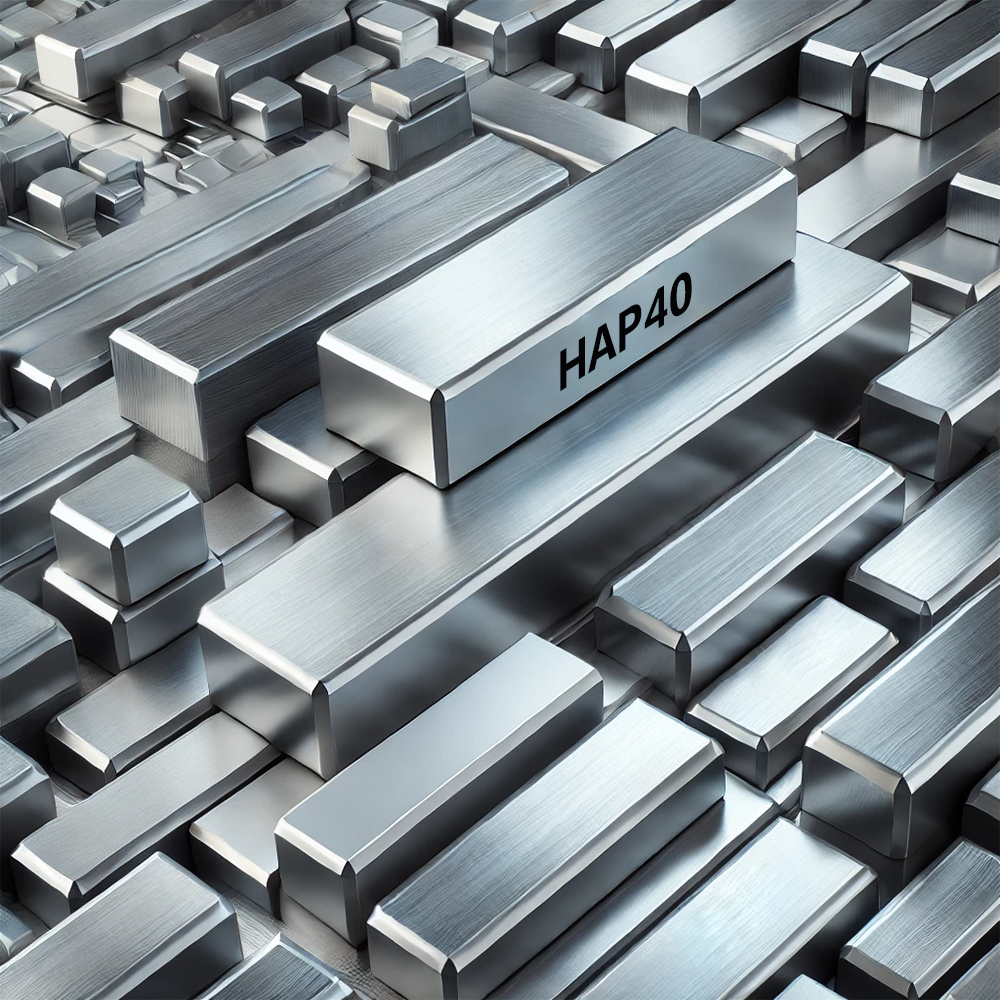
HAP40 is a powder metallurgy (PM) high-speed steel developed by Hitachi Metals. It is known for its high wear resistance, excellent toughness, and superior hardness, making it one of the top choices for cutting tools, punches, and industrial dies.
Due to its powder metallurgy (PM) process, HAP40 has a uniform microstructure, leading to better toughness and grindability than conventionally produced high-speed steels like M2 or M42. It is widely used in applications that require high wear resistance, thermal stability, and precision cutting performance.
Key Features
- Superior Hardness & Wear Resistance: With a hardness of 64-67 HRC, HAP40 outperforms conventional high-speed steels in cutting tool durability.
- Excellent Heat Resistance: The cobalt content provides thermal stability, allowing tools to maintain hardness under high-speed and high-temperature cutting conditions.
- Improved Toughness & Grindability: Thanks to powder metallurgy technology, HAP40 has a fine and uniform microstructure, reducing the risk of cracking and edge chipping.
- High-Temperature Performance: Suitable for high-speed cutting applications, hot forming dies, and precision machining.
Chemical Composition
| Element | Composition (%) |
| Carbon (C) | 1.27 – 1.37 |
| Silicon (Si) | 0.45 |
| Manganese (Mn) | 0.30 |
| Chromium (Cr) | 3.80 – 4.50 |
| Molybdenum (Mo) | 4.50 – 5.50 |
| Tungsten (W) | 5.50 – 6.50 |
| Vanadium (V) | 2.70 – 3.30 |
| Cobalt (Co) | 8.00 – 9.00 |
Note:
- Cobalt (Co) enhances hot hardness and heat resistance, making HAP40 superior in high-speed applications.
- Tungsten (W) & Molybdenum (Mo) improve wear resistance and strength.
- Vanadium (V) increases toughness and hardness retention.
Mechanical Properties
| Property | Value |
| Hardness (Annealed) | ≤ 280 HB |
| Hardness (Hardened & Tempered) | 64 – 67 HRC |
| Tensile Strength | ~2,400 MPa |
| Yield Strength | ~2,000 MPa |
| Elongation | 3 – 5% |
| Impact Toughness | Excellent (compared to traditional HSS) |
Key Advantages:
- Higher toughness than M42 and M2
- Better grindability due to fine microstructure
- Resistant to chipping and cracking
- Can maintain sharpness longer in cutting applications
HAP40 vs. M42 vs. M2 (AISI)
| Property | HAP40 | M42 | M2 |
| Hardness (Tempered) | 64-67 HRC | 67-69 HRC | 62-65 HRC |
| Wear Resistance | Excellent | Excellent | Good |
| Toughness | Superior | Moderate | Good |
| Grindability | Better | Moderate | Good |
| Thermal Stability | Excellent | Good | Moderate |
| Edge Retention | Superior | Excellent | Good |
| Applications | Cutting tools, dies, molds | High-speed cutting tools | General-purpose cutting tools |
Applications
HAP40 is widely used in industries requiring high wear resistance, precision, and durability, including:
Cutting Tools
- End mills, drills, reamers, taps, and gear cutting tools
- Knives and industrial blades (e.g., woodworking, paper, plastic, and metal cutting)
Punching & Stamping Dies
- Punching and blanking dies for stainless steel, titanium, and high-strength alloys
- Fine blanking dies for automotive and aerospace parts
Molds & Dies
- Injection molds for plastics and rubber
- Extrusion dies requiring high resistance to thermal fatigue
High-Performance Industrial Blades
- Precision blades for metalworking, electronics, and semiconductor industries
Heat Treatment Process
Annealing
- Heat to 800–850°C, then slowly cool in a furnace.
Hardening
- Preheat at 850–900°C, then heat to 1,150–1,200°C, followed by oil or gas quenching.
Tempering
- Temper at 540–560°C (twice or three times) to achieve optimal hardness (64-67 HRC).
Surface Treatment
- PVD/CVD Coating (TiN, TiCN, AlTiN) for enhanced abrasion resistance
- Cryogenic Treatment to further improve wear resistance and dimensional stability
Alternative Materials
- M42 (AISI): Higher cobalt content (8-10%), making it harder than HAP40 but more brittle. Best for high-speed cutting tools but lacks toughness for impact applications.
- M2 (AISI): A general-purpose high-speed steel with good toughness and wear resistance, but lower hardness and thermal stability than HAP40.
- ASP2052 (Bohler-Uddeholm): A powder metallurgy high-speed steel similar to HAP40 with excellent wear resistance and toughness.
Conclusion
HAP40 is a high-performance powder metallurgy high-speed steel offering superior wear resistance, hardness, and toughness compared to conventional HSS like M2 and M42. Its fine microstructure and high-temperature performance make it ideal for cutting tools, dies, and molds in industries that demand precision, durability, and thermal stability.