
S50C Carbon Steel Detailed Information
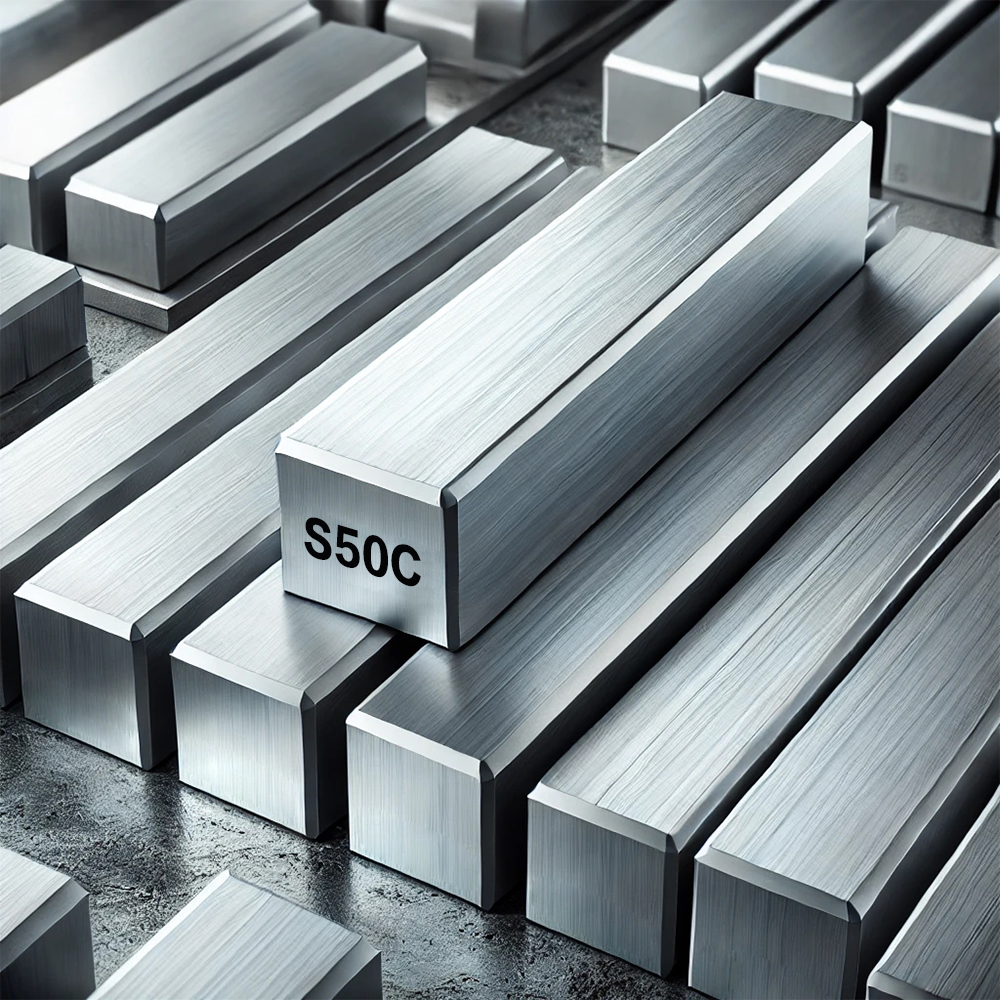
S50C is a medium carbon steel that belongs to the JIS G4051 standard. It is equivalent to AISI 1050 and DIN 1.1210. Known for its good strength, machinability, and wear resistance, S50C is widely used in mold bases, machinery parts, gears, and shafts.
Key Features
Good Machinability
- Easy to cut, mill, and drill, making it ideal for mold bases and mechanical parts.
Good Strength & Wear Resistance
- Can withstand moderate loads and friction, suitable for shafts, gears, and rollers.
Moderate Hardening Ability
- Can be hardened through quenching and tempering to improve mechanical properties.
Weldability
- Not ideal for welding due to high carbon content, but pre-heating can reduce cracking risk.
Cost-Effective
- Cheaper than alloy steels, making it widely used in general engineering applications.
Chemical Composition
| Element | Composition (%) |
| Carbon (C) | 0.47 – 0.53 |
| Silicon (Si) | 0.15 – 0.35 |
| Manganese (Mn) | 0.60 – 0.90 |
| Phosphorus (P) | ≤ 0.030 |
| Sulfur (S) | ≤ 0.035 |
- Moderate Carbon Content → Provides high hardness and strength after heat treatment.
- Manganese Addition → Improves hardenability and toughness.
Mechanical Properties
| Property | Value |
| Density | 7.85 g/cm³ |
| Tensile Strength | 610 – 850 MPa |
| Yield Strength | ≥ 335 MPa |
| Elongation | ≥ 15% |
| Hardness (Annealed) | ≤ 180 HB |
| Hardness (Hardened & Tempered) | 200 – 300 HB |
| Thermal Conductivity | 50.9 W/m·K |
| Melting Point | 1,510 – 1,550°C |
- High Tensile Strength, making it suitable for load-bearing components.
- Good machinability, allowing easy cutting, drilling, and milling.
S50C vs. Other Carbon Steels
| Property | S50C (AISI 1050) | S45C (AISI 1045) | S55C (AISI 1055) |
| Carbon Content (%) | 0.47 – 0.53 | 0.42 – 0.50 | 0.52 – 0.58 |
| Strength & Hardness | Higher | Moderate | Highest |
| Machinability | Good | Better | Fair |
| Weldability | Limited | Better | Poor |
| Wear Resistance | Good | Moderate | Best |
Why Choose S50C?
- Stronger than S45C, with better wear resistance.
- Easier to machine than S55C, but still offers good hardness.
Applications
Mold Base Material
- Used in plastic molds, die-casting molds, and stamping dies.
Machine Parts & Components
- Gears, shafts, rollers, guide rails, and wear plates.
Automotive Industry
- Crankshafts, connecting rods, and suspension parts.
Construction & Engineering
- Structural parts and load-bearing components.
Tools & Fixtures
- Jigs, fixtures, and cutting tools.
Heat Treatment Process
Annealing
- Heat to 850 – 870°C, then slow cooling in a furnace.
- Improves machinability and reduces hardness.
Hardening (Quenching)
- Heat to 820 – 870°C, then oil or water quenching.
- Increases hardness and wear resistance.
Tempering
- Heat to 500 – 650°C, then air cool.
- Adjusts hardness and improves toughness.
Normalization
- Heat to 840 – 900°C, then air cool.
- Refines grain structure and improves mechanical properties.
Alternative Materials
- S45C (AISI 1045) → Lower carbon content, better weldability.
- S55C (AISI 1055) → Higher hardness, but harder to machine.
- SCM440 (AISI 4140) → Alloy steel with better strength and toughness.
Conclusion
S50C carbon steel is a strong, wear-resistant, and machinable material, commonly used in mold bases, machinery, automotive, and structural applications.
Best for: Mold bases, gears, shafts, and machine parts.
Why Choose S50C? It offers a balance of strength, machinability, and cost-effectiveness.